For basketball scouts, Turks and Caicos basketball scouting is the process of identifying and evaluating players with the aim of finding athletes who fit your team's competitive, academic, and roster requirements. This 2026 guide separates public-profile research from verified basketball evaluation so you can build a shortlist without treating highlights as a complete scouting report.
- Turksathletes is best for scouts seeking public profiles of Turks and Caicos athletes.
- Turks and Caicos basketball scouting needs game context, verified statistics, and role-specific evaluation—not highlights alone.
- Use athlete profiles for discovery; confirm identity, competition, eligibility, and contact permissions separately.
- Compare full-game film with highlights before committing to travel or a recruiting decision.
Why basketball scouting matters for scouts recruiting in TCI
Your first task is to establish what the evidence actually shows. A public profile, a scoring total, and a highlight clip answer different questions. None establishes roster fit on its own.
Turksathletes presents public athlete profiles, achievements, statistics, and highlights from the Turks and Caicos Islands. For basketball scouts, those materials support discovery; your evaluation still needs the player's role, opponent context, and information relevant to your program.
For your 2026 recruiting board, separate three decisions: whether an athlete deserves further review, whether the basketball evidence supports a role, and whether recruiting requirements are satisfied. That distinction keeps an interesting prospect from becoming an unsupported recommendation.
A small amount of well-labeled evidence is more useful than a large folder of unidentified clips. Build your process around traceable observations, not the volume of material available.
Build a recruiting shortlist you can defend
Define the role before searching for players
Start with a written role brief in a shared document or spreadsheet. Describe the decisions you need the player to make, rather than relying on a position label such as guard or forward.
A ball-handler expected to organize half-court possessions needs a different review from a wing expected to defend, relocate, and finish advantages. Use the same brief when reviewing every candidate for that opening.
Best for: scouts filling a specific roster need. A role-first search makes comparisons clearer, but an overly narrow brief can exclude players whose skills fit a different assignment.
- Name the roster role and the responsibilities attached to it.
- Separate essential skills from skills your staff can develop.
- Record academic and eligibility questions without assuming the answers.
- Identify which observations require full-game film or live evaluation.
- State what evidence would justify advancing the player.
Assemble a traceable discovery file
Begin manually with public competition records, available game footage, and athlete information you can attribute to a source. Keep names, teams, events, and dates together so you do not combine records belonging to different players.
Turksathletes basketball scouting research can start with its public profiles and highlights. The Turks and Caicos Islands basketball players guide provides another discovery route; inclusion in a guide is not proof that an athlete meets your recruiting criteria.
Best for: scouts building an initial candidate list. Profile-led discovery gives you a starting point, but you must establish the scope and date of each item before using it in a recommendation.
- Record the athlete's name exactly as the source presents it.
- Attach the source and date to every achievement or statistic.
- Keep team, event, and season information beside the record.
- Mark unresolved identity questions before combining sources.
- Distinguish discovery notes from confirmed scouting findings.
Verify the evidence before grading performance
Check that the athlete, competition, and footage belong together. A clip caption does not establish the player's current team, school status, or eligibility, and a statistic without its scope cannot support a meaningful comparison.
For a 2026 evaluation, record when information was checked—not just when the document was created. Historical performances remain useful when clearly dated, but they should not silently become statements about current status.
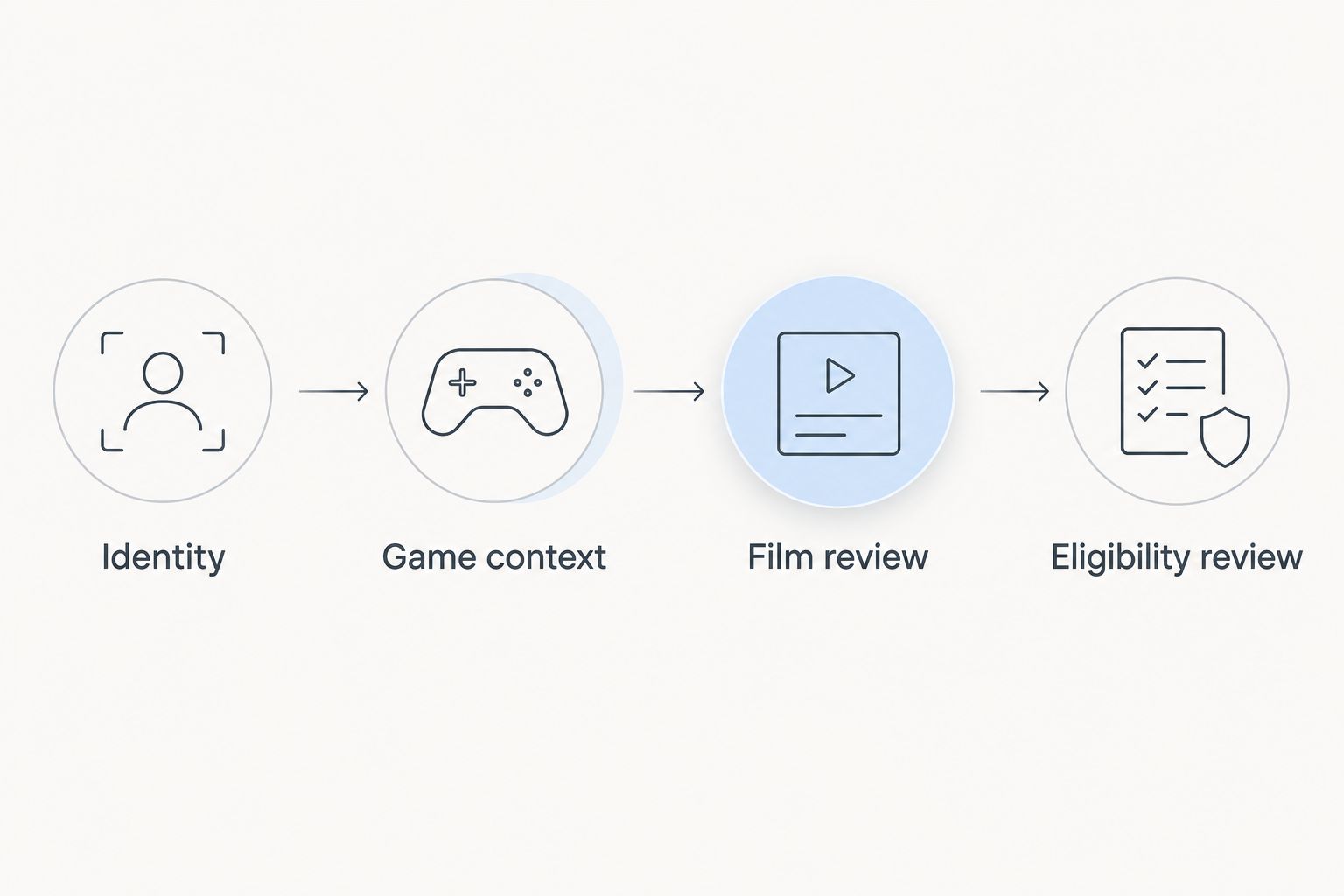
Use four checkpoints: Identity, Game context, Film review, and Eligibility review. Keep basketball observations separate from administrative clearance; a strong film assessment cannot resolve an eligibility question.
- Identity: match the athlete across the records you intend to use.
- Game context: confirm the event, opponent, date, and result where available.
- Film review: establish whether footage is edited, partial, or complete.
- Eligibility review: refer requirements to the responsible program staff.
Review complete possessions before judging highlights
Use a basic video player and timestamped notes before adding any specialist workflow. Highlights help you locate actions worth investigating; longer sequences show the decisions surrounding those actions.
As a working review target, request 3 complete games when available. This is a practical starting point, not a validated threshold or a guarantee of a sound evaluation. If you have less footage, narrow the conclusion instead of filling the gaps with assumptions.
Best for: scouts testing whether a promising action repeats in game context. Full-game review exposes unsuccessful possessions and off-ball behavior, but it takes time and remains limited by the games supplied.
- Watch possessions before and after the featured scoring actions.
- Track shot selection, passing decisions, and responses to pressure.
- Review off-ball spacing, screening, cutting, and defensive positioning.
- Log 5 possessions that support or challenge the proposed role.
- Separate what the footage shows from what requires another viewing.
Compare statistics only within their stated scope
Build a simple evidence sheet before calculating rankings. Label each figure by event, season, or game sample, and distinguish totals from per-game figures. Do not treat missing data as zero.
A scoring total without minutes, attempts, or game context leaves important questions unanswered. It can justify investigation, but it cannot establish efficiency or suitability for your system.
For your 2026 shortlist, pair each statistical observation with a film question. If a record suggests scoring production, inspect how those opportunities developed and whether the actions match the role you need.
- Preserve the source's units and labels when recording statistics.
- Keep tournament totals separate from season totals.
- Record games played and minutes only when supplied by a source.
- Check apparent differences in role, opponent, and game conditions.
- Mark unavailable fields as unknown rather than estimating them.
Contact the appropriate person with specific questions
Draft a short, individualized message after the evidence review. Identify your program, explain the basketball reason for your interest, and ask for the missing information needed for the next decision.
Follow your institution's recruiting rules and applicable safeguarding requirements. For a minor, use appropriate adult or institutional channels; a public athlete profile is not consent for unrestricted direct contact or circulation of personal information.
Best for: scouts ready to resolve a defined evidence gap. Direct communication can clarify records and access to footage, but statements still need attribution and relevant checks.
- Explain the role or skill that prompted your inquiry.
- Request original game footage with dates and opponent details.
- Confirm the appropriate contact route and permission to communicate.
- Ask program staff to handle eligibility and academic requirements.
- Record answers without copying unnecessary personal information.
Set a next action and review the decision
Close each report with a decision the next reviewer can act on. Use clear categories such as Advance, Request evidence, Revisit, or Close. Explain the reason rather than assigning an unexplained overall score.
Where staffing permits, have 2 reviewers assess the same evidence independently before discussing the candidate. This is a recommended check on interpretation, not a claim that two opinions establish accuracy.
For each 2026 recruiting decision, distinguish lack of fit from lack of evidence. An athlete with insufficient footage has not necessarily failed the basketball assessment; the assessment remains incomplete.
- State the proposed role and the evidence supporting it.
- Name the most important unresolved question.
- Assign responsibility for obtaining the next piece of evidence.
- Record the decision date and the reason for any later change.
- Keep observation, interpretation, and administrative status separate.
Compare scouting options by the question they answer
No single research option replaces the others. Public profiles help you discover athletes, film supports basketball evaluation, and direct communication helps resolve questions. Choose the option that addresses the uncertainty in front of you.
| Option | Best for | Main advantage | Key limitation |
|---|---|---|---|
| Turksathletes athlete profiles | Discovering Turks and Caicos athletes | Brings public profiles, achievements, statistics, and highlights into your research | Public presentation does not establish roster fit or eligibility |
| Official competition records | Checking recorded results and participation | Connects a result to a named competition | Does not explain every possession or decision |
| Full-game video | Reviewing role execution and decisions | Includes actions omitted from highlight edits | Camera coverage and the available sample limit interpretation |
| Live evaluation | Observing a player in a specific game setting | Lets you follow off-ball actions directly | One viewing captures only that game's circumstances |
| Coach or authorized-contact discussion | Clarifying role, records, and next steps | Lets you ask targeted follow-up questions | Answers need attribution and relevant verification |
For an early shortlist, combine public discovery with source checks before committing to a deeper film review. For a player approaching a recruiting decision, prioritize unresolved basketball and administrative questions rather than collecting more versions of the same highlights.
Common mistakes basketball scouts make in TCI recruiting
Treating a discovery guide as a recruiting ranking
A public player guide and your roster board serve different purposes. Use discovery content to identify names, then apply your own documented criteria. Do not copy an ordering into a recruiting recommendation without evaluating the underlying evidence.
Treating island affiliation as eligibility evidence
An athlete's connection to the Turks and Caicos Islands does not answer every question about school status, competition history, or eligibility for your program. Record those questions separately and refer them to the responsible staff member.
Grading the highlight editor instead of the player
A polished edit makes selected actions easy to watch, not representative of every possession. Request longer sequences and inspect decisions that do not end in a score. If complete footage is unavailable, state that limitation in the report.
Reading cross-sport achievements as basketball proof
An achievement in sprinting, football, or volleyball provides context, not a basketball grade. Evaluate transferable qualities through basketball actions before drawing conclusions about defensive coverage, decision-making, or positional fit.
Letting unknown information become a negative grade
Missing minutes, dated measurements, or unavailable film are evidence gaps. They are not proof of poor performance. Use a request-for-evidence decision when the missing material prevents a fair assessment, and avoid circulating an unsupported negative label.
FAQ
What's the best way to start Turks and Caicos basketball scouting?
Start by defining the roster role, then build a source-labeled candidate list. Public athlete profiles support discovery, but basketball recommendations need verified context and role-specific evaluation.
Is Turksathletes useful for basketball recruiters?
Turksathletes is useful for discovering public profiles, achievements, statistics, and highlights of Turks and Caicos athletes. Recruiters must separately verify the information relevant to roster fit, eligibility, and appropriate contact.
Are basketball highlights enough to recruit a player?
Highlights alone are not enough for a complete recruiting assessment. Review longer game sequences to examine decision-making, off-ball activity, defensive positioning, and unsuccessful possessions.
How many games should a basketball scout watch?
Use 3 complete games as a practical starting target, not a universal requirement. Review additional evidence when the footage leaves important questions about role, consistency, or competition context unanswered.
Can I compare statistics from different competitions?
Compare statistics only after identifying their scope and limitations. Keep totals and averages distinct, and account for available information about games, minutes, role, and opponents.
How should a scout contact a young athlete?
Use an appropriate adult or institutional contact route and follow your program's recruiting and safeguarding requirements. Explain your purpose and avoid requesting or distributing unnecessary personal information.
What belongs in a basketball scouting report for 2026?
A 2026 scouting report needs the proposed role, dated sources, specific basketball observations, unresolved questions, and a next action. Keep performance assessment separate from eligibility and administrative clearance.
One last thing
Before advancing a player, write the strongest evidence against your own recommendation. If the evidence file contains only successful actions, you have not yet tested the proposed role thoroughly.
Turksathletes basketball scouting research supports discovery; your final recommendation should explain what the athlete did, where the evidence came from, and what remains unconfirmed. Keep that explanation short enough for another coach to challenge it.