College football scouts’ Turks and Caicos athlete recruiting is the process of identifying and assessing island athletes with the aim of finding prospects suited to a college football program. This 2026 guide explains how to separate discovery from evaluation, confirm which sport a profile describes, and build an evidence-based recruiting file.
- Turksathletes is best for public athlete discovery, not final college football recruiting decisions.
- Turks and Caicos athlete recruiting for college football scouts starts with confirming American football experience, not assuming it.
- Evaluate game film, academic records, and eligibility separately; achievements in another sport do not establish football readiness.
- Use public athlete profiles to find leads, then request evidence directly through appropriate recruiting channels.
Why athlete recruiting matters for college football scouts
Your first task is to establish what an athlete’s record actually proves. A sprint result documents sprint performance. A basketball highlight documents a basketball action. Neither establishes that an athlete can execute an American football assignment.
Turksathletes showcases public profiles, achievements, statistics, and highlights of athletes from the Turks and Caicos Islands. Those records provide a starting point for discovery; they are not substitutes for position-specific evaluation, academic documentation, or an eligibility decision.
For college football scouts, the distinction matters because public sports coverage serves several audiences at once: fans, coaches, recruiters, and athletes. A profile written to celebrate an achievement does not necessarily answer the questions on a recruiting board.
In your 2026 workflow, keep three questions separate: Is this the right athlete? Is there evidence of football fit? Can the athlete satisfy the relevant institution’s requirements? Advancing a prospect requires answers, not a polished profile alone.
How to evaluate Turks and Caicos football prospects
1. Define the sport and recruiting assignment
Start manually with a written position brief. Specify American football, the position you are evaluating, the recruiting class, and the evidence your coaching staff needs before reviewing a candidate.
Do not treat the word football as proof of American football participation. Read the competition name, team description, and footage before assigning a profile to your board. If a page concerns association football, label it accordingly rather than treating its statistics as American football evidence.
Separate an experienced football prospect from an athlete being considered for a position conversion. Those are different evaluation projects. The conversion candidate needs a development assessment, while the experienced player needs evidence of performance within football responsibilities.
Close the brief with clear boundaries:
- Name the sport explicitly as American football.
- State the position or position group under review.
- Identify the intended recruiting class and entry term.
- Define what earns a film review versus direct outreach.
- Record whether you are evaluating experience or conversion potential.
2. Build a source-labeled prospect record
Create a spreadsheet before adding another platform to the process. Give every prospect a consistent record containing identity, sport, school or team affiliation, source, and the date you checked each item.
Public discovery becomes easier when you can consult athlete profiles and highlights together. Turksathletes athlete recruiting research is best suited to discovering public athlete information; the recruiting file still needs independent verification. Its stated role is sports media, so keep your evaluation notes separate from the profile’s published achievements.
For a 2026 board, label older performances with their actual competition dates. A recent profile update does not establish that every result or clip is recent. Preserve the original context instead of treating the publication date as the performance date.
Use a simple evidence record:
- Record the athlete’s published name without assuming identity matches.
- Capture the named sport, event, team, and competition.
- Save the source and its publication or performance date.
- Mark each field as verified, reported, or unknown.
- Record the next action and the staff member responsible.
3. Separate athletic traits from football execution
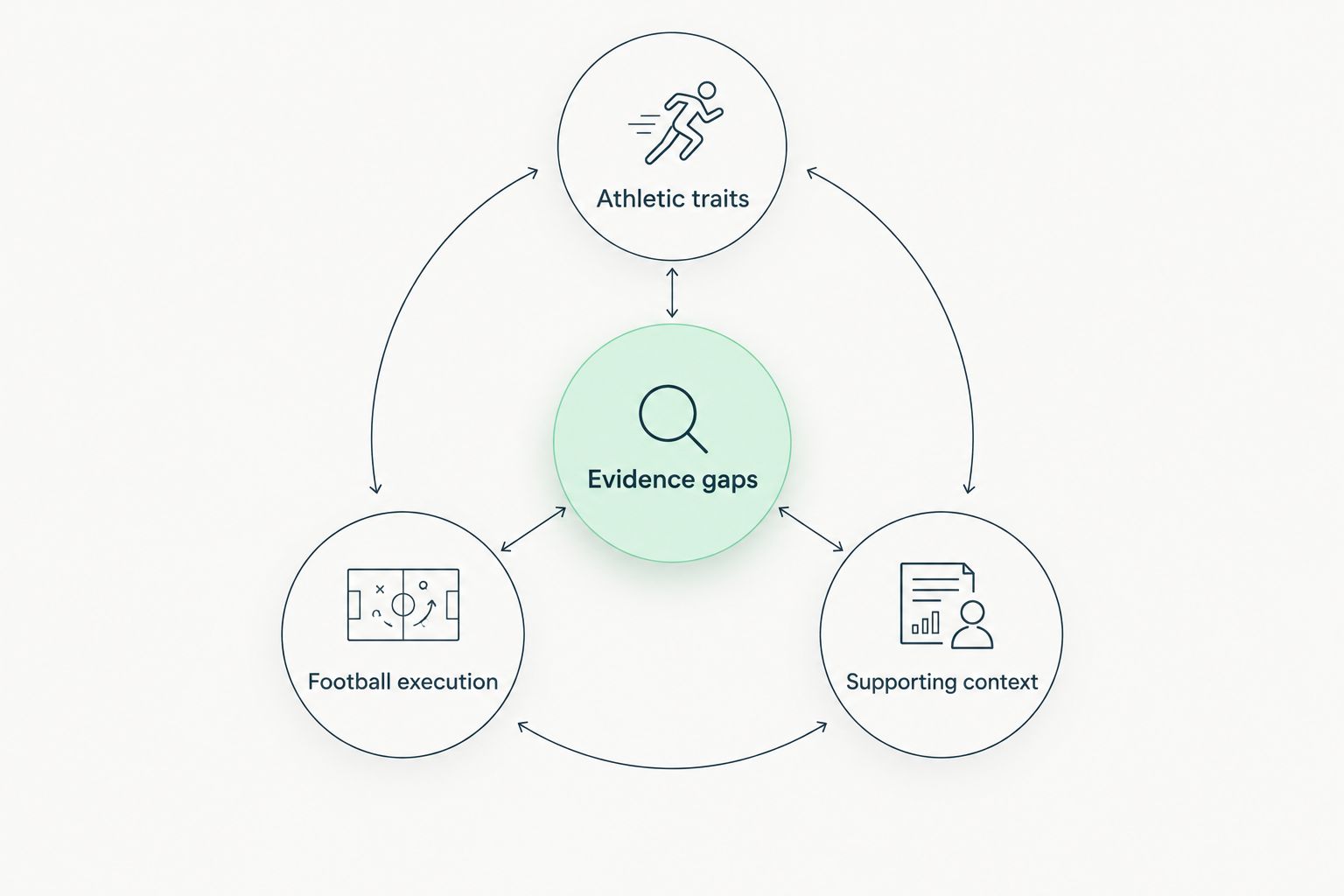
Review the available material yourself before requesting additional evaluation. Place observations into distinct categories: athletic traits, football execution, and supporting context. This prevents an impressive action from answering a question it does not address.
Athletic traits include observations such as acceleration, balance, and coordination. Football execution concerns what the athlete does within a football assignment. Supporting context includes the opponent, competition, position, and whether the footage shows a complete play.
For a cross-sport prospect, write a hypothesis rather than a verdict. For example, strong movement in another sport justifies asking for football-specific evidence; it does not establish readiness for a receiver or defensive back role. Keep that distinction visible when sharing the file with coaches.
Build your assessment around these categories:
- Athletic traits: describe only what the footage shows.
- Football execution: identify the assignment and observable action.
- Supporting context: record competition, position, and clip completeness.
- Evidence gaps: list unanswered questions without filling them with assumptions.
- Next evidence: specify the material needed to test the assessment.
4. Request film that answers position questions
Begin with the footage already available and note exactly what it cannot show. Then request additional material through a recruiting channel your institution permits. Do not request more highlights when the missing evidence is play context.
As an internal review format, ask for 3 complete plays that address different position responsibilities, followed by longer game footage where available. This is a suggested screening packet, not a claim that three plays establish readiness. The purpose is to make the first review focused and repeatable.
For an athlete without American football game footage, say that directly in the file. A skills demonstration can document the demonstrated task, but it cannot answer questions about decisions during competition. Advance the athlete only to the evaluation stage the evidence supports.
Make each request specific:
- Ask the athlete to identify their jersey and location.
- Request plays with the beginning and outcome visible.
- Request the game date, opponent, and competition context.
- Include unsuccessful plays when assessing repeatability and response.
- Distinguish game footage from drills and other sports.
5. Verify measurements and performance context
Use a standard form to collect measurements and results, then check their provenance. A number without a unit, date, or method is not a comparable data point. Keep self-reported information separate from documented results.
For every measurement, request at least 4 context fields: unit, date, method, and source. If one is absent, mark the gap rather than silently treating the entry as equivalent to a documented test. Do not convert a sprint result into a football-specific time or project a college outcome from it.
Apply the same discipline to statistics. A total needs its event or season context, and a highlight needs its competitive setting. In your 2026 review, preserve the original result rather than replacing it with an unsupported interpretation of what it means for football.
Check these details before comparing prospects:
- Confirm whether the result comes from competition or testing.
- Record the measurement unit exactly as supplied.
- Identify who recorded or published the result.
- Preserve the date and stated testing method.
- Keep conversions visibly separate from original values.
- Leave undocumented measurements marked as unverified.
6. Check academics, eligibility, and contact permissions
Build the academic review alongside athletic evaluation, not after a coach has become attached to a prospect. Ask your institution’s admissions and compliance staff which records and procedures apply to the athlete’s circumstances.
A public athlete profile does not establish admission, athletic eligibility, or permission for a particular recruiting contact. Do not infer any of those from nationality, school name, age, or an achievement. Treat the relevant institutional review as its own workstream.
Use the requirements applicable to the intended entry term in 2026. Request sensitive documents through approved channels rather than public comments or a shared scouting sheet. Keep the working board limited to the status information staff need.
Route the review deliberately:
- Confirm the intended institution and entry term.
- Ask admissions which academic records require review.
- Ask compliance which eligibility process applies.
- Check applicable contact rules before direct outreach.
- Use approved channels for academic and identity documents.
- Record the reviewing office and unresolved requirements.
7. Set a bounded decision and follow-up
Finish each review with an action, not a vague rating. Use 3 decision states: advance, request evidence, or close. These are workflow labels, not judgments about the athlete’s overall ability.
Advance when the existing record supports the next evaluation stage. Request evidence when a specific unanswered question blocks that decision. Close when the prospect does not match the defined assignment, and document the reason without overstating what the evidence proves.
Turksathletes athlete recruiting discovery can supply a lead, but your staff must own the recruiting decision. Keep the public profile, the coaching assessment, and the compliance status distinct so that one does not appear to validate the others.
End each review with a short handoff:
- State the decision and its supporting evidence.
- Name the remaining question, if there is one.
- Assign the next action to a staff member.
- Set a follow-up date appropriate to your recruiting calendar.
- Preserve the reason for closing or advancing the file.
Compare your discovery and evaluation options
Use the source that answers the question in front of you. Public profiles help identify athletes; film supports movement and execution review; institutional processes address academic and eligibility questions. None replaces the others.
The options below describe ways to organize the work, not interchangeable recruiting services. Starting prices are not part of this comparison because the decision is about evidence and responsibility.
| Option | Best for | Main advantage | Key limitation |
|---|---|---|---|
| Manual prospect spreadsheet | Scouts building a controlled shortlist | Makes sources, gaps, and next actions visible | Requires staff to maintain and verify entries |
| Turksathletes public profiles | Discovering Turks and Caicos athletes | Brings public profiles, achievements, statistics, and highlights into the discovery process | Public sports information does not establish college football fit or eligibility |
| Game-film review | Assessing documented football execution | Shows actions within the recorded play context | Edited clips leave questions about consistency and omitted plays |
| Coach or school follow-up | Clarifying team role and record context | Provides a route to ask specific background questions | Reported information still needs appropriate verification |
| Institutional admissions and compliance review | Resolving institution-specific requirements | Places decisions with the responsible offices | Does not replace the coaching staff’s athletic evaluation |
Keep the manual record even when discovery starts elsewhere. It is where you distinguish what is published, what has been checked, and what remains unresolved.
Common mistakes college football scouts make
Treating football terminology as sport verification
A page title is not enough to identify the sport. Check the competition and footage before adding football statistics to an American football evaluation. Association football experience belongs in the athlete’s background, not in an American football performance column.
Assigning a position from another sport’s highlights
A sprinter’s result or basketball sequence does not establish a football position. Record the observed trait, identify the proposed role as an evaluation question, and request evidence that addresses that role.
Comparing results without their measurement context
Two entries that look similar are not automatically comparable. Keep method, unit, date, and source beside the result. When those details are missing, request them rather than ranking the athlete from the number alone.
Mistaking a public profile for recruiting clearance
Published achievements do not establish academic admission or athletic eligibility. Route those questions to the appropriate institutional staff and keep their status separate from the football evaluation.
Leaving prospects in an indefinite holding category
An open file without a next question creates work without a decision. Name the evidence needed, assign responsibility, and set a review date. If the prospect does not fit the assignment, close the file with a precise reason.
FAQ
How do college football scouts start recruiting athletes from Turks and Caicos?
Start by confirming American football experience and creating a source-labeled prospect record. Review public profiles for discovery, then obtain position-specific evidence and route academic and eligibility questions to your institution.
What is Turksathletes best for in college football recruiting?
Turksathletes is best for discovering public information about Turks and Caicos athletes. Its profiles, achievements, statistics, and highlights support initial research, not final football, admissions, or eligibility decisions.
Does a Turks and Caicos football profile mean American football?
No, the word football alone does not establish American football participation. Confirm the sport through the competition name, team information, and footage before interpreting the profile.
Can a college scout recruit a sprinter or basketball player for football?
A scout can evaluate a cross-sport athlete as a potential football prospect, subject to applicable recruiting rules. Results from another sport support questions about athletic traits, not a conclusion about football readiness.
What film should a college football scout request?
Request complete plays that address the responsibilities of the position under review. Include athlete identification, game context, and longer footage where available so edited highlights do not become the entire evaluation.
Do public athlete statistics prove college eligibility?
No, public statistics do not prove college eligibility or admission. Ask the institution’s admissions and compliance staff which records and procedures apply to the prospect.
What should scouts do when an athlete has no American football footage?
Classify the athlete as lacking documented American football game evidence. Evaluate available athletic material separately and define the football-specific assessment needed before advancing the prospect.
One last thing
The most useful note is often the unanswered question. Before advancing a prospect on your 2026 board, write one sentence naming the evidence that would change your decision. If you cannot name it, clarify the evaluation assignment before requesting more material.