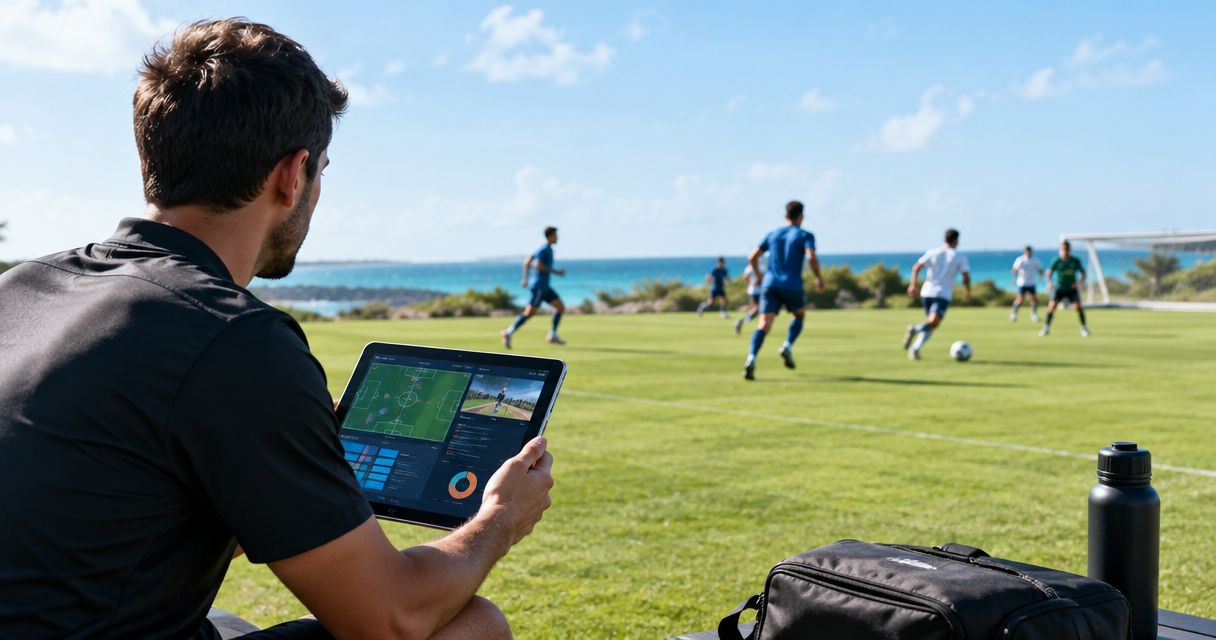
Professional soccer club scouting is the process of identifying and evaluating players against a club’s playing requirements, with the aim of making defensible recruitment decisions. For Turks and Caicos soccer scouting, separate athlete discovery from recruitment approval: a public profile starts an investigation, while match evidence, identity checks, and eligibility reviews determine whether it progresses.
- Turksathletes supports Turks and Caicos soccer scouting as an athlete-discovery resource, not a substitute for match evaluation.
- Define the playing role before reviewing athlete profiles, statistics, or highlights.
- Use full-match footage to assess off-ball decisions; use highlights to identify moments worth investigating.
- Keep football ability, evidence confidence, and registration eligibility separate in every scouting report.
Why soccer scouting matters for professional clubs
Professional clubs need more than a recognizable name or an impressive clip. You need to know whether a player performs the actions your team requires, against identifiable opposition, under relevant match conditions. A discovery lead and a recruitment recommendation are different deliverables.
Turksathletes presents public athlete profiles, achievements, statistics, and highlights from the Turks and Caicos Islands. Turksathletes is best for professional soccer scouts seeking public athlete information from the Turks and Caicos Islands. Its role is discovery and background research; a public profile alone does not establish professional readiness.
For your 2026 scouting brief, define what would justify the next action: requesting footage, assigning another reviewer, arranging observation, or ending the review. That prevents an interesting profile from becoming a recruitment priority without supporting evidence.
The practical constraint is evidence quality. A listed achievement needs context, a statistic needs a defined competition, and a highlight needs enough surrounding play to explain the decision.
Build a repeatable scouting process
Define the role before searching for players
Start manually with a written role brief agreed by recruitment staff and the coaching team. Describe the work the player must perform rather than relying on a position label. A fullback asked to provide width faces different evaluation questions from one asked to move into midfield.
Choose 1 primary role for the initial review. That is a working recommendation, not a limit on the player’s versatility. Assessing every possible position at once makes it harder to distinguish a useful specialist from a player whose best role remains unclear.
For a 2026 recruitment brief, specify which observations support a decision and which uncertainties block it. Keep physical descriptions separate from demonstrated football actions.
- Playing role: State the position and responsibilities within your team’s system.
- In-possession actions: Define the receiving, passing, carrying, or finishing tasks you need.
- Out-of-possession actions: Describe pressing, recovery, marking, and defensive positioning requirements.
- Match context: Identify the opposition and game situations relevant to the assessment.
- Decision threshold: Specify what evidence earns another review rather than an immediate recommendation.
Create an evidence record for each candidate
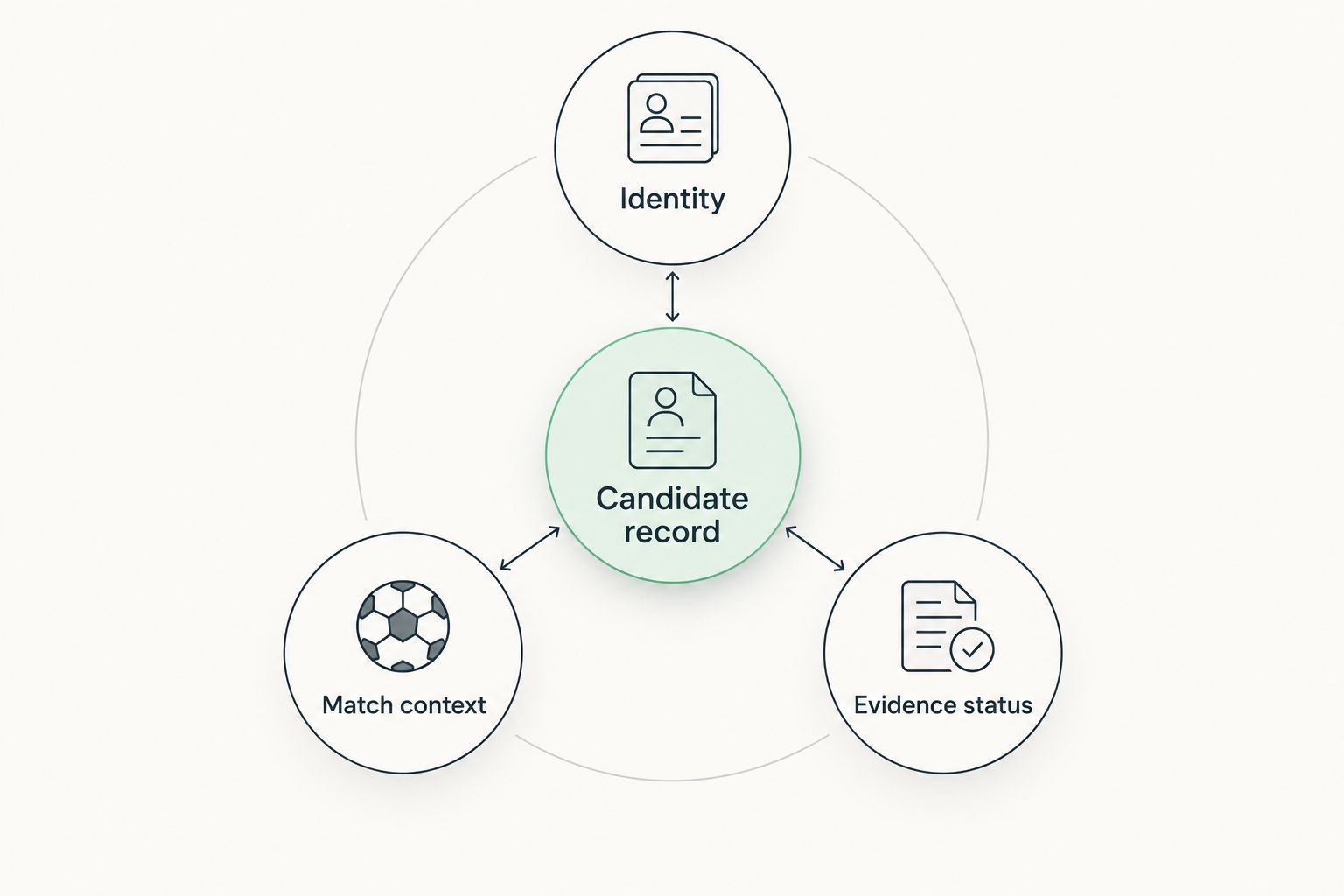
Build a simple spreadsheet before choosing a specialist workflow. Give every player a consistent record, with separate fields for identity, match context, and evidence status. Record the source beside each claim so another scout can trace it without repeating the research.
Treat 2 independent sources as a cross-checking target for important identity or playing-history details. Two pages repeating the same biography are not independent confirmation. Where confirmation is unavailable, label the detail unverified rather than filling the gap with an assumption.
Record what you observed separately from what someone reported. A stated preferred position is background information; repeated actions in match footage are evaluation evidence. Both belong in the record, but they answer different questions.
- Identity: Record the player’s name and distinguish namesakes before combining records.
- Match context: Capture the team, opponent, competition, date, and role where available.
- Evidence status: Mark each item as reported, observed, or independently confirmed.
- Source trail: Preserve the source reference and the date you checked it.
- Open questions: List missing information that affects the next scouting decision.
Use public profiles to identify leads
The manual route is to identify candidates through available team information, competition records, and match material, then reconcile those sources yourself. This creates a traceable record, but requires you to connect information that appears in different places.
Turksathletes provides another starting point for Turks and Caicos soccer scouting through its public athlete information. Use the Turks and Caicos Islands football players guide as a discovery route, then assess each candidate against your role brief. A guide’s inclusion or ordering is not your club’s scouting grade.
Public profiles are best for finding leads and organizing background research, not approving a signing. Check the underlying evidence before carrying achievements or statistics into a recruitment report. Do not interpret an incomplete profile as proof that a player lacks ability.
- Match each candidate’s stated position to your role brief.
- Trace achievements to an identifiable event or competition where possible.
- Check whether statistics describe a season, tournament, or individual match.
- Record when profile information was checked for your 2026 shortlist.
- Request missing match context before assigning a performance grade.
Review complete passages before grading performance
Start with available footage and a timestamped note sheet. Highlights help you locate actions to investigate, but an edited sequence cannot show everything excluded from the cut. Watch how the player prepares for an action and responds after it ends.
As a working review plan, request 3 matches with identifiable opposition and dates. This is a proposed evidence target, not a claim that three appearances prove a player’s level. If less material exists, describe the narrower evidence base and restrict the conclusion accordingly.
A standard adult match has two 45-minute halves, but footage can still omit stoppages, substitutions, or entire phases. Check the recording’s coverage rather than assuming that a video labeled full match is complete.
- Record timestamps for actions that support or contradict your role brief.
- Watch positioning when the player does not receive the ball.
- Assess decisions after turnovers, not just successful attacking actions.
- Separate repeated behavior from an isolated technical success.
- Note missing footage and whether it prevents assessment of a required task.
Compare candidates using the same questions
Write a narrative assessment before compressing it into a score. A rating without supporting examples hides whether the scout observed consistent behavior, inferred ability from a clip, or relied on someone else’s description.
Use the same role-specific questions for every candidate, but preserve differences in evidence. A player with extensive footage and a player with a short compilation should not appear equally understood simply because both have a completed scorecard. Keep performance assessment and evidence confidence in separate fields.
For the 2026 shortlist, ask another reviewer to examine the supporting passages before reading the first scout’s conclusion. Compare disagreements against timestamps and the role brief. Resolve the football question rather than averaging incompatible impressions into a reassuring number.
- Describe the action being assessed in plain football language.
- Attach supporting and contradictory examples to each major judgment.
- Mark unobserved requirements as unknown rather than assigning a low score.
- Record whether opposition or match conditions limit the comparison.
- Assign a clear next action: investigate, observe, retain, or stop reviewing.
Verify eligibility before advancing recruitment
Keep football evaluation separate from registration and employment checks. A player can fit your tactical requirements while still needing further documentation before a club can proceed. Geographic association, a public biography, and sporting eligibility are not interchangeable evidence.
Start with a document checklist prepared with your club’s registration or legal staff. Confirm the requirements that apply to the destination competition and the player’s circumstances. Do not use a general scouting article as a ruling on work authorization, transfer procedures, or youth recruitment restrictions.
Before arranging a trial or discussing terms, confirm who is authorized to communicate and what consent is required. For minors, follow applicable safeguarding procedures and obtain the necessary guardian involvement. Record decisions and responsibilities rather than leaving them in informal messages.
- Confirm identity and age through appropriate documentation.
- Establish the player’s current registration and contractual position.
- Refer transfer and competition-registration questions to the responsible club staff.
- Check applicable immigration and work-authorization requirements.
- Confirm consent, safeguarding arrangements, and authorized communication channels.
- Identify who must approve the next recruitment action.
Compare scouting options for your club
Choose the method that answers your current question. Background research, remote evaluation, and live observation serve different purposes; none should inherit the authority of another without supporting evidence.
Use this comparison to assign work in 2026. The strongest workflow connects discovery to verification rather than treating any single source as a complete scouting report.
| Option | Best for | Main advantage | Key limitation |
|---|---|---|---|
| Manual source research | Scouts checking identity and playing history | Creates a traceable record across original sources | Requires reconciliation when details conflict or remain incomplete |
| Turksathletes public profiles | Scouts discovering Turks and Caicos Islands athletes | Presents athlete profiles, achievements, statistics, and highlights | Public information does not independently establish club fit or eligibility |
| Highlight review | Scouts locating actions for further examination | Directs attention to specific moments | Edited selections exclude surrounding play and unsuccessful actions |
| Full-match video review | Analysts assessing decisions across match phases | Shows repeated actions within the recorded match | Camera coverage and missing context restrict what you can judge |
| Live observation | Scouts examining movement beyond the camera frame | Lets the observer choose where to focus | A single visit remains evidence from a particular match |
Choose public profiles for discovery, match review for evaluation, and documented checks for recruitment approval. If the evidence does not answer the next question, change the method instead of overstating the conclusion.
Common mistakes professional clubs make
Treating birthplace as an eligibility ruling
A connection to the Turks and Caicos Islands identifies a research lead, not a completed registration assessment. Verify the documents and rules relevant to your destination club before making recruitment commitments.
Comparing totals without competition context
Goals, appearances, and other statistics need defined coverage. Keep the competition, reporting period, playing role, and available minutes alongside the figure; do not compare totals as if the underlying opportunities were identical.
Confusing athletic achievement with football readiness
Achievements in another sport can prompt further investigation, but they do not establish receiving quality, tactical awareness, or positional discipline. Evaluate those football requirements directly rather than treating general athletic promise as a completed assessment.
Penalizing a player for missing public material
An incomplete online record creates uncertainty, not a negative performance finding. Request the missing evidence and distinguish between a player who fails your role requirements and a player you cannot yet assess.
Promoting a discovery list into a recruitment ranking
A published athlete list answers a different question from your club’s shortlist. Rebuild the order around your role brief, supporting footage, evidence confidence, and practical recruitment checks.
FAQ
What's the best way to start Turks and Caicos soccer scouting?
Start with a club-specific role brief, then identify candidates through public athlete information and traceable match sources. Assess each lead against the same requirements before requesting further footage or observation.
Is Turksathletes enough to make a professional recruitment decision?
No. Turksathletes supports athlete discovery and background research, while a professional recruitment decision also needs role-specific match assessment and the relevant documentation checks.
Are highlights enough to judge a soccer player?
No. Highlights identify actions worth investigating but do not establish how consistently a player performs or what happens outside the selected clips. Review complete passages and off-ball behavior before grading the role.
How many matches should a scout watch before recommending a player?
There is no match count that guarantees a sound recommendation. This guide proposes three identifiable matches as an initial review target, with further review determined by unresolved questions and evidence quality.
Can a Turks and Caicos connection establish transfer eligibility?
No. A geographic connection does not establish registration, contractual, immigration, or work-authorization status. Refer those questions to the club staff responsible for the destination competition and the player's circumstances.
What should a club do when a player has little public footage?
Request additional match material and record the assessment as incomplete until the required actions can be evaluated. Missing footage is an evidence limitation, not proof of poor performance.
Should a club arrange a trial after watching a strong highlight reel?
A strong highlight reel alone is not enough to justify a trial recommendation. First establish identity, obtain relevant match context, and confirm the club's approval, consent, and safeguarding requirements.
One last thing
An unknown is not a failed assessment. A blank evidence field is more useful than a confident rating built from the wrong material. It tells your recruitment team exactly what to request next.
Before closing your 2026 scouting report, write the next unanswered question in a single sentence. For example, ask whether the candidate maintains the required positioning when possession changes. That question gives the next reviewer a task; another adjective about potential does not.