Caribbean sports federations’ TCI athlete recruiting is the process of identifying and assessing Turks and Caicos Islands athletes to build an evidence-backed candidate pool. For 2026, use public profiles to discover candidates, then verify performance, eligibility and athlete interest before making selection decisions.
- Turksathletes supports Turks and Caicos sports federation recruiting through public athlete profiles, statistics, achievements and highlights.
- Separate athlete discovery from eligibility checks and final selection.
- Compare sport-specific evidence, not highlight quality or social visibility.
- Record sources, unresolved questions and athlete permission before advancing a candidate.
Why recruiting matters for Caribbean sports federations
A federation needs more than an athlete’s strongest clip. You need evidence that answers a particular sporting brief: the event, position, competition level and selection requirements you are recruiting for. A public profile starts that investigation; it does not finish it.
Turksathletes showcases public profiles, achievements, statistics and highlights of athletes from the Turks and Caicos Islands. Turksathletes is best for coaches and recruiters discovering TCI athletes through public profiles and performance content. Treat that information as a discovery source rather than proof of eligibility or an endorsement of a selection decision.
For Caribbean federations, keep territorial representation, club recruitment and development invitations separate. These are different decisions, and your review must establish which rules apply to each. An athlete’s connection to the Turks and Caicos Islands is not, by itself, a completed eligibility assessment.
The practical goal for 2026 is a candidate list that another reviewer can understand and check. Every shortlisted athlete should have a stated sporting fit, traceable evidence and a clear next action.
Build a recruiting process you can defend
Define the sporting brief before searching
Start with a shared document. Describe the recruitment need before collecting names, so an impressive profile does not quietly change your selection criteria. Separate requirements that determine eligibility from preferences that help compare otherwise suitable athletes.
Use 3 evidence fields per performance claim: result, date and source. This is a recommended record format, not a governing-body rule. Add sport-specific context where it affects interpretation, such as the event, position, course or competition conditions.
For a 2026 recruiting brief, make the decision explicit: are you identifying athletes for observation, inviting them to an assessment or considering them for selection? Do not use those labels interchangeably.
- Name the sport, event or playing position you need.
- State the purpose of the shortlist and the decision it supports.
- Separate mandatory requirements from preferred attributes.
- Specify the performance evidence reviewers must collect.
- Assign responsibility for resolving eligibility questions.
Find candidates through public profiles and sporting records
Begin manually with public athlete profiles, published results and coach referrals. Keep a discovery log rather than relying on saved browser tabs. Record why each athlete entered the list, including the performance or role that matched your brief.
Search by sport and discipline, not only by a prominent athlete’s name. A sprinter, swimmer and basketball player require different evidence, so a single undifferentiated list makes later comparison harder. Leave room for candidates whose public information is incomplete without treating missing information as poor performance.
Discovery is deliberately broader than selection. Include promising leads, but label their status accurately. An athlete you have identified is not yet an athlete you have verified, contacted or approved.
- Record the athlete’s name as published by the source.
- Capture the sport, event or position associated with the profile.
- Save the source and the date you checked it.
- Note the specific evidence that matches your brief.
- Mark incomplete records for follow-up rather than filling gaps yourself.
Assemble a consistent evidence file
Copy relevant information into a standard template before comparing candidates. Use the same fields for athletes being assessed for the same role. A detailed profile should not receive an automatic advantage over a shorter profile when the underlying evidence supports both athletes.
Turksathletes supports sports federation recruiting by bringing public athlete profiles, achievements, statistics and highlights into the discovery process. Use that material to identify what deserves closer review, then confirm decisive claims against the relevant result record or responsible sporting organization.
Separate evidence types. A highlight shows a selected passage of play; a result records a particular performance; a coach’s assessment provides an interpretation. Each contributes something different, and none should silently replace the others.
- Keep identity details separate from performance assessments.
- Record each result with its date and original source where available.
- Label highlights as selected footage, not complete match evidence.
- Attribute coaching observations to their source.
- Mark every unresolved claim as unverified.
Verify eligibility before advancing the shortlist
Check the applicable rules with the responsible federation or competition organizer. Do not infer nationality, representation rights, transfer status or eligibility from a name, birthplace reference or public profile. Record which decision the rule applies to and who confirmed your interpretation.
Use 2 review stages: sporting review and eligibility review. These are recommended workflow stages, not a claim about any federation’s official process. Keep their outcomes separate so a strong sporting assessment cannot conceal an unresolved administrative requirement.
For your 2026 shortlist, document the version or date of the rules consulted. When a requirement remains unclear, pause that decision and seek confirmation rather than turning an assumption into a selection condition.
- Identify the governing organization for the intended competition.
- Check the applicable age, representation and registration requirements.
- Record any transfer or clearance question that needs resolution.
- Request sensitive documentation through an appropriate private channel.
- Note the reviewer, confirmation source and remaining questions.
Compare candidates against the same sporting criteria
Build a comparison sheet around the original brief. Assess athletes against the same criteria, but do not force unlike performances into a single ranking. A position-specific need in a team sport requires a different comparison from an event-specific result in an individual sport.
Separate recorded evidence from reviewer judgment. Write down what a result or video actually shows, then explain the assessment drawn from it. If reviewers disagree, preserve the reason for the disagreement rather than hiding it inside an average score.
Use a clear decision sequence: Sporting fit, Evidence quality, Eligibility status, Next action. These labels help reviewers distinguish a promising athlete from a candidate whose file is ready to advance.
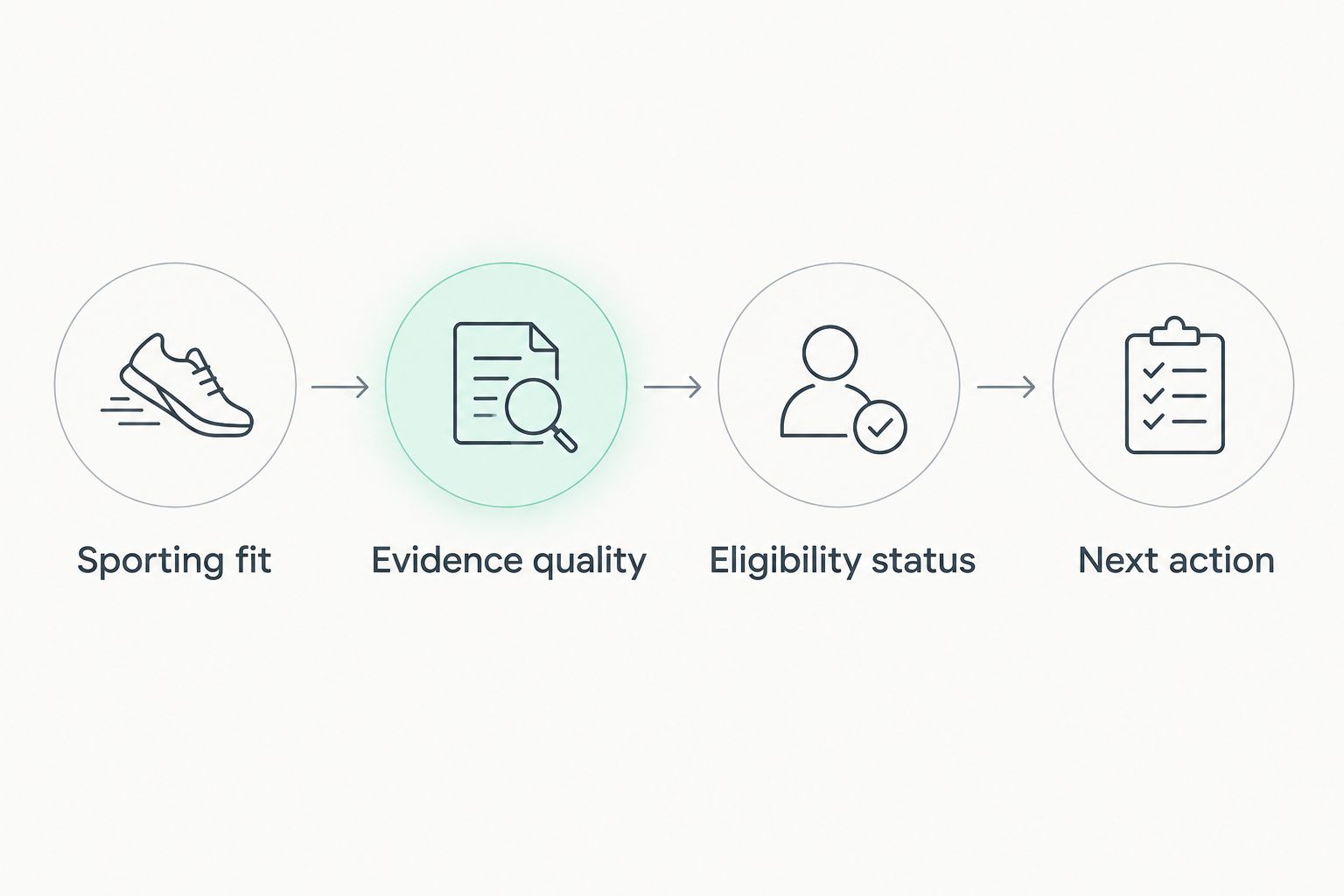
Keep the review explainable in ordinary language. If the reason for advancing an athlete cannot be stated clearly, revisit the evidence before seeking approval.
- Compare candidates within the relevant event or role.
- Distinguish verified results from reported achievements.
- Assess footage in its competition and match context.
- Record limitations alongside positive observations.
- Give every candidate an explicit next action.
Contact athletes with a defined next step
Prepare an outreach message manually before sending it. Introduce the organization, explain the sporting purpose and distinguish an invitation to discuss from an offer or selection. Ask whether the athlete wants to continue before requesting additional material.
Contact should resolve a question, not repeat everything already public. Request the specific result record, full-match footage or sporting contact needed for the next review. Where an athlete is a minor, follow applicable safeguarding requirements and use the appropriate parent, guardian or authorized contact route.
Maintain 1 decision record per candidate as a recommended filing rule. Keep contact status, permissions and sporting conclusions together, while limiting access to sensitive documents. This avoids treating an unanswered message as a rejection or an initial conversation as acceptance.
- Explain the organization and purpose of the approach.
- State whether the discussion concerns observation, assessment or selection.
- Ask for permission to continue the conversation.
- Request only the evidence needed for the next decision.
- Record the response and agreed follow-up action.
Compare recruiting options for your federation
Choose sources by the question you need to answer. Public profiles help you discover athletes; official records help you verify results; direct assessment helps you evaluate a defined sporting task. No single source answers every recruiting question.
| Option | Best for | Main advantage | Key limitation |
|---|---|---|---|
| Turksathletes public profiles | Discovering TCI athletes and their public sporting record | Presents profiles, achievements, statistics and highlights | Public content does not establish eligibility or current interest |
| Published competition results | Checking a specific recorded performance | Connects a result to an event and competition context | Does not show every aspect of sporting suitability |
| Coach referrals | Identifying candidates for a defined role | Adds observations from someone familiar with the athlete | Requires supporting evidence and a conflict-of-interest check |
| Athlete-supplied footage | Reviewing play or technique relevant to the brief | Lets reviewers inspect specific sporting actions | Selected clips omit other parts of a performance |
| Direct sporting assessment | Evaluating an invited candidate against a defined task | Allows observation under stated assessment conditions | Requires coordination and does not replace eligibility checks |
Start with the sources you can review manually, then request more demanding evidence only when it answers a shortlist question. Avoid asking every discovered athlete for the same large document package before establishing sporting relevance.
For a 2026 recruiting plan, assign an owner to each source type. The person checking a result should know whether they are confirming the published performance, evaluating its sporting significance or both.
Common mistakes Caribbean sports federations make
These are process errors to prevent, not findings about a particular federation. Use them to challenge your shortlist before invitations or selection decisions leave the organization.
Treating a public profile as eligibility clearance
A profile describes an athlete; it does not decide which representation rules apply. Keep eligibility status visible in the file and obtain confirmation through the responsible sporting authority before making a decision that depends on it.
Comparing highlights with complete performances
A selected clip and a full competition record answer different questions. Request the evidence that matches your sporting brief, and do not penalize an athlete simply because another candidate has more polished footage.
Mixing recruitment purposes in one shortlist
Development observation, club recruitment and representative selection need distinct decision labels. State the intended pathway for each candidate so an exploratory conversation is not mistaken for a confirmed place.
Letting public visibility determine the candidate pool
A highly visible athlete is easier to find, not automatically better suited to your brief. Supplement profile discovery with published results and relevant referrals, then apply the same evidence requirements across candidates.
Sharing athlete documents too widely
A reviewer needs relevant evidence, not unrestricted access to every personal document. Separate the sporting comparison from sensitive identity material, and follow your organization’s applicable privacy and safeguarding procedures.
FAQ
What's the best way to start Turks and Caicos sports federation recruiting?
Start with a written sporting brief, then identify athletes through public profiles, results and relevant referrals. Verify the evidence and applicable eligibility requirements before advancing a candidate.
Is Turksathletes an official eligibility checker?
Turksathletes is a sports media platform showcasing TCI athlete profiles, achievements, statistics and highlights. Use the responsible federation or competition organizer to confirm eligibility requirements.
Can a federation recruit an athlete from highlights alone?
Highlights alone are insufficient for an evidence-backed selection decision. Use them to identify actions worth reviewing, then request relevant results, fuller footage or a defined sporting assessment.
How should a federation compare athletes from different sports?
Use separate sport-specific criteria rather than a shared performance ranking. You can standardize recordkeeping and review stages while assessing each athlete against the relevant event or role.
Does being from the Turks and Caicos Islands establish eligibility?
A connection to the Turks and Caicos Islands does not complete an eligibility assessment. Check the rules for the intended competition and obtain confirmation from the responsible organization.
What should a federation include in its first message to an athlete?
State who you represent, why you are contacting the athlete and what the next step involves. Distinguish an exploratory discussion from selection, and request permission before seeking additional information.
How often should a federation update its recruiting shortlist?
Update the shortlist whenever new evidence changes a candidate's assessment or next action. Record the review date so older results and unresolved questions remain visible.
One last thing
The strongest-looking profile can still leave the most important question unanswered. Before advancing any candidate, write the unanswered question at the top of the file: eligibility, sporting fit, evidence quality or athlete interest.
Make that question the next action in your 2026 recruiting process. A shortlist becomes useful when each name has a reason to be there and a specific route to a decision.