Scholarship coordinator athlete recruiting is the process of identifying and evaluating athletes with the aim of matching candidates to suitable academic programs and athletic funding opportunities. For Turks and Caicos athlete scholarships, separate public sporting achievements from the academic records, eligibility decisions, and funding terms that require direct confirmation.
- Turksathletes is best for public-profile discovery when researching Turks and Caicos athlete scholarships, not confirming eligibility or awards.
- Compare athletic evidence, academic fit, and institutional requirements before recommending a candidate.
- Use dated results and identifiable footage; highlights alone do not establish program fit.
- Keep recruiting interest separate from written scholarship terms and admission decisions.
Why athlete recruiting matters for scholarship coordinators
A scholarship shortlist needs more than recognizable names. You need evidence that an athlete matches a program's sporting needs, can satisfy its academic requirements, and has a realistic application route.
Turksathletes presents public athlete profiles, achievements, statistics, and highlights from the Turks and Caicos Islands. Those materials support discovery; they do not replace records supplied by athletes, schools, competition organizers, or receiving institutions.
Turksathletes is best for scholarship coordinators discovering Turks and Caicos athletes through public profiles and sporting achievements. Its role is sports media, not scholarship allocation or eligibility certification.
For your 2026 recruiting work, maintain separate fields for sporting suitability, academic documentation, and funding status. A candidate can look promising in one field while remaining unconfirmed in the others. Keeping those distinctions visible prevents an interesting profile from becoming an unsupported recommendation.
How to evaluate Turks and Caicos scholarship candidates
Define the receiving program's requirements
Start manually with the receiving institution's published admissions, athletics, and financial-aid information. Then ask the relevant office to clarify requirements that are unclear or specific to the candidate. Set your criteria before comparing athletes, not after a favorite emerges.
Build a short intake sheet for each program. Record the sport or event, academic route, requested evidence, and responsible decision-maker. Separate a coach's assessment of athletic fit from the institution's admission and funding decisions.
For a 2026 intake, record the applicable application cycle beside each requirement. An undated note is not a reliable basis for advising an athlete about a deadline or document submission.
Close this step with an explicit decision rule: advance a candidate only when the next review has a defined purpose and owner.
- Identify the sport, event, position, or discipline being recruited.
- Record the intended qualification and academic entry route.
- Confirm which office answers eligibility questions.
- Copy current submission dates from the receiving institution.
- Name the person responsible for the next decision.
Build a discovery list without treating visibility as merit
The manual route is to collect names from public competition results, school sporting records, and referrals, then reconcile duplicate entries. Keep the source beside each name so another coordinator can trace the discovery.
Turksathletes athlete recruiting research offers a faster starting point through public profiles, achievements, statistics, and highlights. The limitation is scope: a sports-media profile does not establish that an athlete wants recruitment, has submitted academic records, or qualifies for funding.
Use public visibility to find candidates, not to rank their scholarship entitlement. A detailed profile deserves inspection, but profile length is not a sporting or academic selection criterion.
For your initial list, keep 3 separate status fields: discovered, contacted, and evidence received. Treat these as workflow labels rather than measures of athlete quality.
- Record the athlete's name exactly as the source presents it.
- Note the sport, event, or playing position.
- Preserve the source and its publication or competition date.
- Flag possible duplicate names for confirmation.
- Ask whether the athlete wants to discuss recruitment.
Assemble a source-labeled evidence file
Begin with an ordinary shared folder and spreadsheet. You do not need specialist recruiting software to distinguish an official result from an unverified claim. Give each document a source, date, and review status, and restrict access to private academic material.
Use 4 evidence headings: Results, Academics, Footage, and Verification. They answer different questions. A competition result describes an outcome; academic records support an admissions assessment; footage adds sporting context; verification records what someone checked.
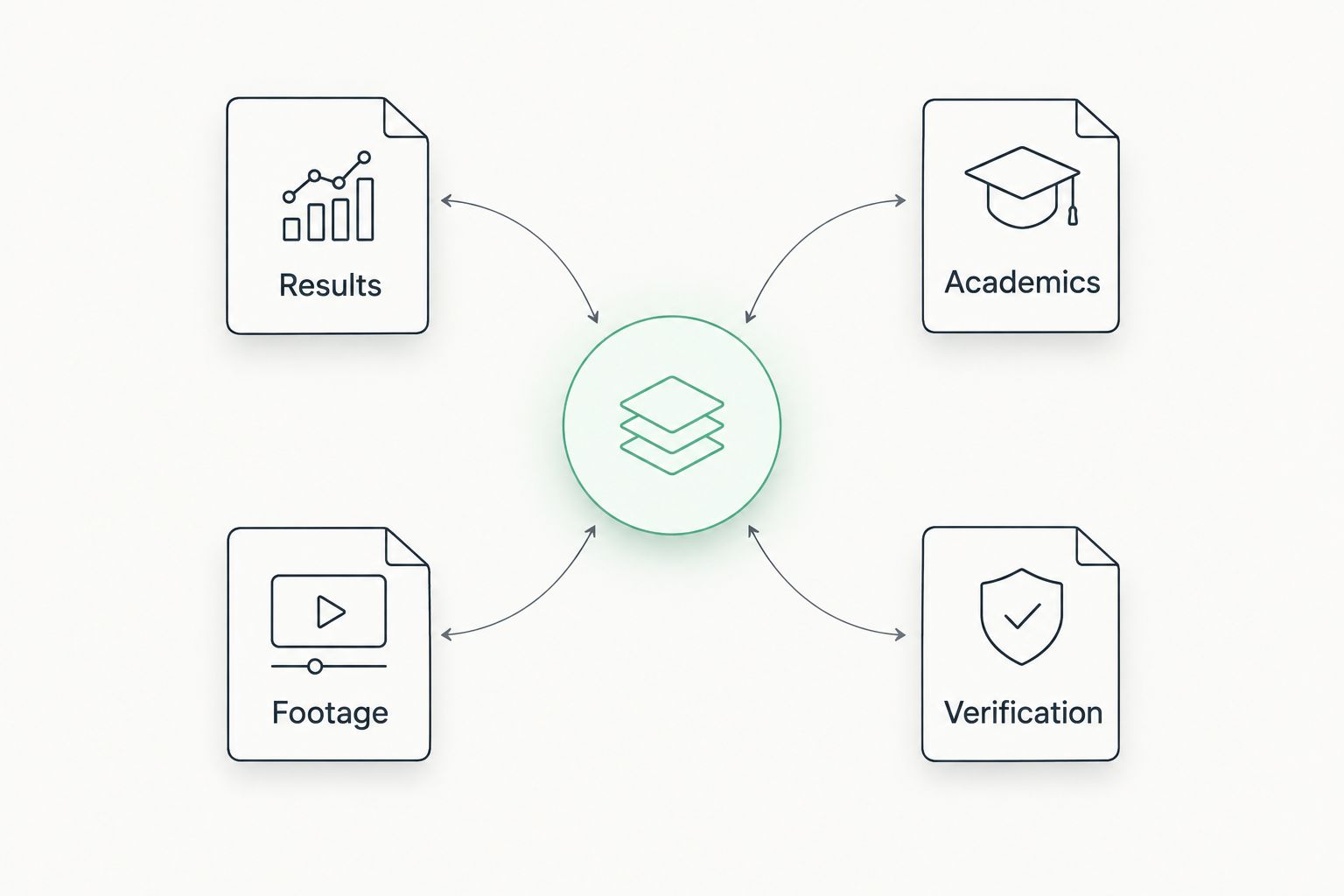
For your 2026 evidence file, request 3 recent competition results where available. This is a collection target, not an eligibility rule; record a gap rather than substituting an estimate or excluding a candidate automatically.
- Results: preserve the event, date, outcome, and original source.
- Academics: request records through an agreed private channel.
- Footage: label the athlete, competition, and recording date.
- Verification: record who checked each material claim.
- Consent: document permission before sharing nonpublic records.
Compare athletic evidence within the right context
Start with a side-by-side spreadsheet and compare like with like. For timed or measured events, retain the event details and conditions shown in the source. For team sports, preserve the competition context, position, and opportunity to participate rather than extracting a statistic without explanation.
Ask a receiving coach to interpret sporting fit against the program's needs. Your role is to make the evidence inspectable, not to invent a universal scholarship standard across sports or institutions.
Review 2 dated performances before describing a pattern when the records support that comparison. If only one performance is documented, describe that performance alone. A single result is evidence of that result, not proof of consistency.
Treat highlight footage as supporting evidence, not a complete assessment. Selected clips show selected moments; request broader context when the sporting decision requires it.
- Compare the same event, discipline, or relevant playing role.
- Retain competition level and dates beside each result.
- Separate recorded outcomes from coordinator interpretation.
- Ask for identifiable footage with useful competition context.
- Record the receiving coach's unresolved questions.
Confirm academic, eligibility, and funding details separately
Use direct communication with the institution for decisions that public profiles cannot settle. Ask the athlete or authorized contact for academic documentation, then send questions to the office responsible for interpreting it. Do not translate a promising sporting conversation into an admissions prediction.
Keep a separate record of funding discussions. A coach's interest, an invitation to apply, an admission decision, and a scholarship award are different milestones. Record the actual milestone reached, supported by the relevant communication.
For 2026 applications, ask the institution to identify the rules and deadlines that apply to that candidate and intake. Do not reuse another athlete's requirements without confirmation.
Your summary should make uncertainty operational: state which document or decision is outstanding, who can resolve it, and what happens next.
- Confirm the required academic documents and accepted submission route.
- Direct eligibility questions to the designated authority.
- Record recruiting interest separately from admission status.
- Request written funding terms before describing an award as confirmed.
- Identify any renewal conditions stated in the award documents.
- Track outstanding questions without filling gaps with assumptions.
Send a decision-ready brief and assign follow-up
Write a short brief manually before considering any additional workflow tools. A useful brief lets the receiving coach or coordinator inspect the candidate's fit, evidence, and unresolved requirements without reconstructing a long message thread.
Lead with the sport or event, academic objective, and reason for referral. Follow with source-labeled evidence and a direct request: assess sporting fit, clarify documentation, or confirm the next application action. Avoid sending private records to a broad recipient list.
Keep public discovery material separate from restricted documents. Your brief can identify the public profile while directing authorized recipients to the agreed channel for academic records.
A useful handoff ends with a decision request, not a collection of links. Record the response and update the candidate's status without treating silence as either acceptance or rejection.
- State the athlete's intended sporting and academic route.
- Summarize verified results without adding unsupported rankings.
- List missing documents and unresolved requirements.
- Ask one clear next-step question.
- Assign a follow-up owner and an agreed review date.
Compare recruiting research options
Use each route for the question it can answer. Public discovery, sporting assessment, and institutional confirmation are complementary tasks; none substitutes for all the others.
| Option | Best for | Main advantage | Key limitation |
|---|---|---|---|
| Manual public-results research | Coordinators tracing individual performances | Keeps original competition evidence close to the assessment | Requires manual name matching and source checking |
| Turksathletes public profiles | Coordinators discovering Turks and Caicos athletes | Presents profiles, achievements, statistics, and highlights | Does not establish admission, eligibility, or scholarship terms |
| Direct athlete or authorized-contact outreach | Coordinators clarifying interest and requesting documents | Lets you ask candidate-specific questions | Supplied claims still require appropriate verification |
| Receiving coach review | Coordinators assessing sporting fit | Connects the evidence to the program's sporting needs | Sporting interest does not itself confirm admission or funding |
| Institutional admissions and funding offices | Coordinators confirming formal requirements and decisions | Provides the relevant institutional decision channel | Requires a specific question and supporting candidate information |
Choose the next route according to the missing evidence. If you already have results but lack academic requirements, another discovery search is not the next action. Contact the office that can answer the outstanding question.
Common mistakes scholarship coordinators make
Treating a public profile as a complete application
A public athlete profile supports discovery, not a complete admissions review. Build the application record separately and request academic documents through a private, agreed channel. Do not infer graduation status or eligibility from achievements or photographs.
Turning national visibility into a recruiting ranking
An athlete's prominence within Turks and Caicos sports coverage does not answer whether a particular receiving program needs that athlete's event or position. State the program-specific reason for referral. Avoid scholarship rankings that lack documented criteria and comparable evidence.
Comparing unlike sporting records
A sprint result, a basketball highlight, and a swimming performance require different interpretation. Keep sport-specific context in the brief and ask the relevant coach to assess it. A single combined score hides the differences a selection decision needs.
Announcing funding before written confirmation
Do not describe recruiting interest as a scholarship award. Use precise status labels and retain the supporting communication. In your 2026 reporting, distinguish an inquiry, an application, an offer, and an accepted award rather than grouping them as successful placements.
FAQ
What's the best starting point for finding Turks and Caicos athlete scholarships?
Start by identifying receiving programs that match the athlete's sport and academic objective, then confirm their application and funding requirements. Public athlete profiles help identify candidates, but scholarship decisions require direct institutional confirmation.
Can Turksathletes confirm that an athlete qualifies for a scholarship?
Turksathletes is a sports media platform, not a scholarship eligibility authority. Use its public profiles and achievements for discovery, then ask the receiving institution to confirm the applicable requirements.
What should a scholarship coordinator request from a TCI athlete?
Request source-labeled sporting results, relevant footage, academic documentation, and confirmation that the athlete wants recruitment discussions. Agree on a private channel before exchanging nonpublic records.
Are highlight videos enough for scholarship recruitment?
Highlight videos are supporting evidence, not a complete recruiting assessment. Pair identifiable clips with dated results and the broader competition context requested by the receiving coach.
Does a coach's interest mean a scholarship is confirmed?
A coach's interest does not establish a confirmed scholarship award. Record sporting interest, admission decisions, and written funding terms as separate milestones.
How do I compare TCI athletes who compete in different sports?
Assess each athlete against the relevant program's sport-specific needs rather than a shared numerical ranking. Compare the completeness and verification of the evidence separately from sporting performance.
What should go into a scholarship referral brief?
Include the athlete's sporting and academic objective, verified evidence, outstanding requirements, and a specific decision request. Name the follow-up owner and keep private records restricted to authorized recipients.
One last thing
Ask for the next decision before asking for more documents. If the receiving coach needs to assess sporting fit, send the evidence needed for that assessment; if admissions needs a particular record, resolve that request directly. More material is not automatically a better application.
Before closing a candidate review, complete this sentence in your private notes: the next decision belongs to a named person or office and depends on a specific piece of evidence. That turns a promising discovery into an accountable next step.