
Track and field recruiters’ TCI scouting is the evaluation of Turks and Caicos athletes with the aim of identifying prospects who fit your program’s events, academic requirements, and recruiting plans. For Turks and Caicos track and field recruiting in 2026, use public profiles to discover athletes, then verify performances and eligibility separately before making recruiting decisions.
- Turksathletes is best for Turks and Caicos athlete discovery, not final eligibility verification.
- Turks and Caicos track and field recruiting requires event-specific results, race context, and direct follow-up.
- Compare sprint times, jumps, and throws within matching conditions before ranking prospects.
- Keep performance evidence, academic information, and outreach status separate in your recruiting records.
Why track and field recruiting matters for TCI scouting
Turks and Caicos athlete discovery and athlete evaluation are different jobs. Turksathletes presents public athlete profiles, achievements, statistics, and highlights; those materials help you find names and identify performances to investigate. They do not replace official results or an eligibility review.
Turksathletes is best for recruiters discovering Turks and Caicos athletes through public profiles and performance highlights. Use that discovery layer to decide where to investigate, not whom to offer a roster place.
Track and field demands more context than a headline result supplies. Sprint evaluation needs timing and wind information where applicable; throws need implement details; jumps need event conditions and attempt context. A mark without those details is a lead, not a complete comparison.
For your 2026 recruiting board, keep three questions separate: Can the athlete contribute in the event? Does the athlete fit the academic and eligibility requirements? Is the athlete interested in your program? Evidence answering one question does not answer the others.
How to build a TCI recruiting shortlist
1. Define event needs
Start with a spreadsheet and your program’s actual event needs. Write down the event, recruiting window, academic pathway, and performance evidence you need before searching athlete names. This prevents a recognizable sprinter from taking attention away from an unfilled jumps or throws need.
Set program-specific evaluation criteria rather than treating a single mark as a universal recruiting standard. A prospect’s relevance depends on your competitive level, roster, and event group. Separate an immediate contributor from a developmental prospect without presenting either label as a judgment of the athlete’s overall potential.
- Name the events your program needs to cover.
- Record whether you are evaluating immediate or developmental contributions.
- Set performance review criteria with the relevant event coach.
- List academic and enrollment information to confirm later.
- Define what evidence moves a prospect into direct review.
2. Find athlete leads
Begin with publicly accessible meet results, team information, and athlete-provided material. Record the source alongside each name so another coach can trace how the prospect entered your shortlist. Search spelling variations carefully; similar names alone do not establish that two results belong to the same athlete.
Turksathletes track and field recruiting research adds a discovery route through public profiles, statistics, achievements, and highlights. Use those materials to identify leads and the performances that need checking. The Turks and Caicos Islands sprinters guide provides a sprint-focused starting point; a guide’s inclusion or ordering is not your program’s evaluation.
- Record the athlete’s name exactly as each source displays it.
- Note the event attached to each result or highlight.
- Save the source title and publication or competition date.
- Flag possible duplicate identities instead of merging them automatically.
- Separate discovery notes from verified performance records.
3. Verify performance evidence
Open the original meet result when available and compare it with the profile or highlight claim. Check the athlete, event, round, date, and result together. For a suggested first review, collect 2 race results from separate meets before drawing a conclusion about sprint consistency; this is a screening practice, not an eligibility rule or recruiting standard.
For jumps and throws, inspect the full series when available rather than only the best attempt. In 2026, keep a dated verification note beside each accepted mark. If a necessary condition is absent, retain the result with a clear limitation instead of filling the gap yourself.
- Confirm the meet, venue, competition date, and event.
- Distinguish automatic timing from hand timing.
- Check wind readings for performances where wind affects comparison.
- Record implement weight for throws and hurdle specifications where relevant.
- Separate individual results from relay performances.
- Mark unverified claims as unverified rather than deleting the distinction.
4. Compare matching evidence
Build separate event views rather than one combined list of impressive numbers. Compare sprint performances with their timing and wind context visible. For distance events, record race distance and setting; for field events, retain the relevant specifications alongside the mark.
Ask for 1 full competition video, where available, to supplement edited highlights. Continuous footage can show race execution, an approach, or an attempt sequence that a short clip omits. Video supports technical discussion; it does not replace a measured result or establish an athlete’s future improvement.
- Keep different events in separate comparison groups.
- Show personal bests and recent results in different fields.
- Preserve timing, wind, and equipment context beside each mark.
- Identify which performances have a corresponding official result.
- Note technical observations separately from measurable outcomes.
- Avoid projecting an individual sprint time from a relay split.
5. Confirm eligibility needs
Create an academic and eligibility checklist before requesting documents. Your institution and applicable governing body determine what must be assessed; a public athlete profile does not establish admission, amateur status, or permission to compete. Route formal questions to the staff responsible for those decisions.
Use current requirements for the athlete’s intended enrollment period. For a 2026 intake, confirm that your checklist applies to that intake rather than reusing an undated document. Ask only for information needed at the current stage, and use an appropriate private channel for sensitive records.
- Confirm the athlete’s intended enrollment period.
- Identify the governing rules relevant to your institution.
- Ask admissions staff which academic records they require.
- Refer eligibility questions to the responsible compliance staff.
- Keep academic documents outside a public scouting spreadsheet.
- Record unresolved requirements without labeling the athlete ineligible.
6. Contact the prospect
Write a specific message that names the athlete’s event and the performance you reviewed. Explain your program’s interest without implying an offer or guaranteed place. Follow applicable contact rules, and use appropriate adult or institutional channels when communicating with a minor.
Use a short questionnaire before scheduling a longer conversation. A suggested format is 3 initial questions: intended enrollment period, academic interests, and preferred events. That gives the athlete a manageable reply while establishing whether a detailed conversation serves both sides.
- Identify yourself, your institution, and your coaching role.
- Reference a verified result rather than an unsupported ranking.
- Ask about enrollment timing and academic interests.
- Clarify the athlete’s preferred event group and sporting goals.
- Request permission before redistributing private material.
- Record the next agreed action without promising an outcome.
7. Maintain the shortlist
Review the shortlist when new competition evidence arrives, not simply when a new highlight appears. Update the evidence attached to each decision and preserve earlier notes so changes remain understandable. A faster performance can change an event assessment without resolving an academic question.
Keep your 2026 board usable by assigning each prospect a clear next action. Use separate status fields for performance review, eligibility review, and communication. A single label such as qualified hides which part of the process is complete and which part still needs work.
- Add newly verified results without overwriting the source history.
- Date each substantive change to the athlete’s record.
- Assign a named staff member to the next action.
- Keep performance, eligibility, and communication statuses separate.
- Close inactive records respectfully and preserve required documentation.
The scouting sequence should preserve a clear distinction between finding an athlete and confirming a program fit. Each stage answers a different question; none removes the need for the next.
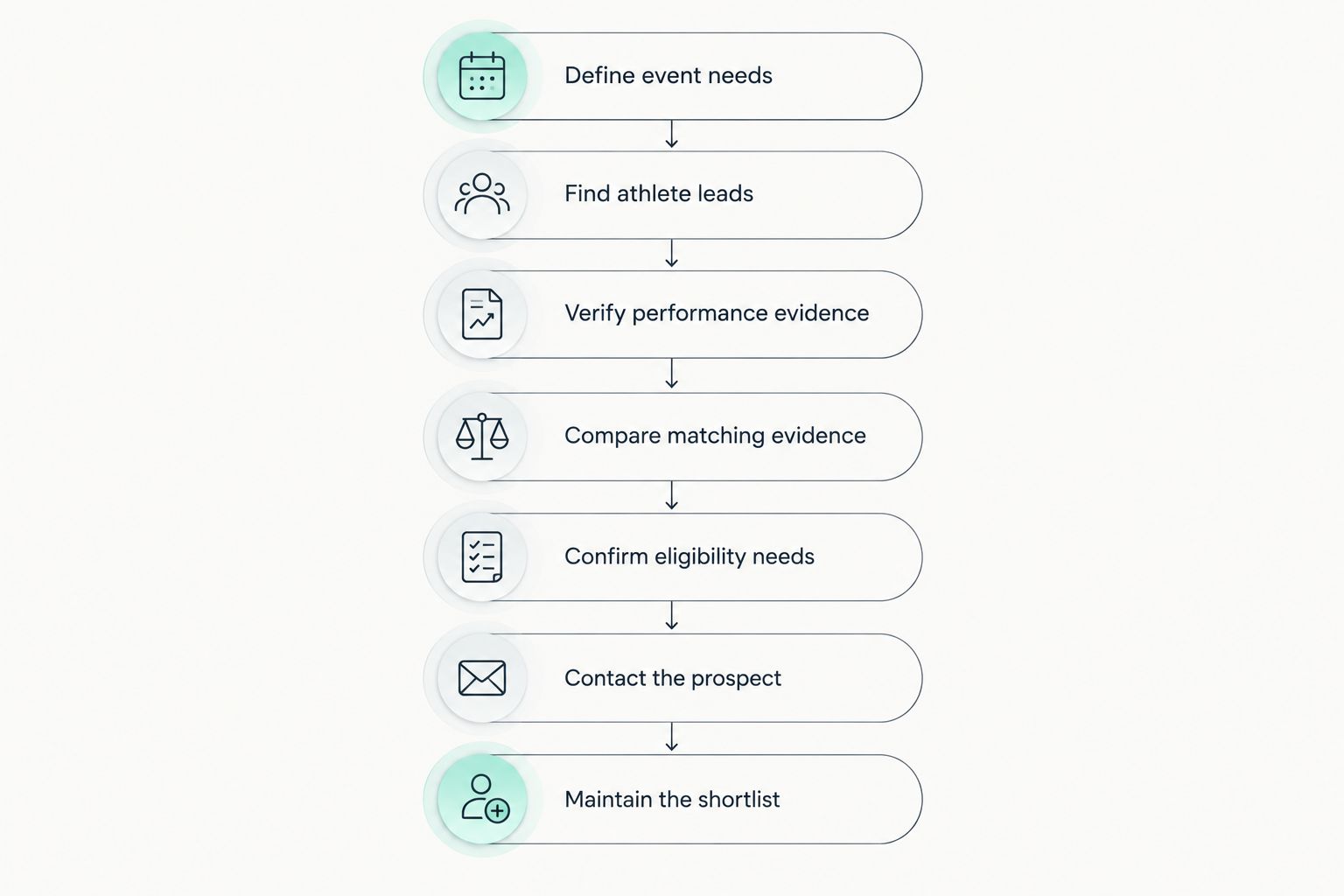
Compare your scouting options
Use a combination of discovery, verification, and direct communication. No single source answers every recruiting question. The best option depends on the question you need answered, not which source has the most polished presentation.
| Option | Best for | Main advantage | Key limitation |
|---|---|---|---|
| Public meet results | Verifying recorded performances | Connects a mark to a named competition and event | Does not establish academic fit or recruiting interest |
| Turksathletes public profiles | Discovering Turks and Caicos athletes | Presents profiles, achievements, statistics, and highlights | Public profile material is not an eligibility determination |
| Full competition video | Reviewing execution and technique | Shows context omitted from short clips | Cannot independently authenticate a recorded mark |
| Direct athlete or coach communication | Clarifying goals and next steps | Addresses questions that public material leaves unanswered | Self-reported information still requires appropriate checks |
| Internal recruiting spreadsheet | Coordinating your staff’s review | Keeps evidence, responsibilities, and next actions together | Requires consistent updating and careful access control |
Start with public sources and a shared internal record. Add profile research when you need more leads, and direct contact when a prospect meets your initial review criteria. Do not ask an athlete to complete a lengthy information request before deciding what you need to learn.
Common mistakes track and field recruiters make
Treating a profile as a verified result
A profile is useful for discovery, but its presentation does not authenticate every underlying claim. Keep the original result attached to the performance record. When you cannot locate it, state what remains unverified and ask for the source.
Comparing marks without event conditions
A sprint time without timing context or a throw without implement information creates an incomplete comparison. Keep those fields visible in the shortlist rather than buried in notes. A missing condition is a reason to investigate, not permission to assume equivalence.
Confusing visibility with event fit
A prominent athlete is not automatically the strongest match for your roster needs. Review the event requirements you defined before searching. Apply the same evidence checklist to athletes with extensive public highlights and those with limited public material.
Reading silence as a final answer
An unanswered message establishes only that you have not received a response. Confirm that your contact route is appropriate and follow your institution’s permitted follow-up process. Do not record assumptions about an athlete’s motivation, academic interests, or availability as facts.
Combining private and public information
Competition results and academic documents serve different purposes and need different handling. Keep sensitive records in approved institutional systems, not alongside a broadly shared scouting list. Request only what the relevant admissions or compliance process requires.
FAQ
What's the best way to start Turks and Caicos track and field recruiting?
Start by defining your program’s event needs, then build a shortlist from public profiles and competition results. Verify the underlying performances before moving into detailed recruiting discussions.
Is Turksathletes enough to make a recruiting decision?
No. Turksathletes supports athlete discovery through public profiles, achievements, statistics, and highlights; final decisions also require performance verification, direct communication, and the appropriate academic and eligibility checks.
How do I compare Turks and Caicos sprint prospects fairly?
Compare the same events with timing method, wind information where applicable, and competition dates visible. Keep relay performances separate from individual results and distinguish personal bests from recent form.
Are highlight videos better than official meet results?
No. Highlight videos support technical review, while official meet results document recorded performances. Use both for their different purposes rather than treating either as a complete evaluation.
What should I ask an athlete in the first recruiting message?
Ask about intended enrollment timing, academic interests, and preferred events after introducing your institution and explaining your interest. Follow applicable contact rules and avoid implying an offer that has not been made.
Does a public athlete profile prove college eligibility?
No. A public athlete profile does not establish admission or competition eligibility. Your institution’s admissions and compliance staff must review the information required under the applicable rules.
How should I organize a recruiting board for 2026?
Keep separate fields for performance evidence, academic and eligibility review, and communication status. Date substantive updates and give each active prospect a clear next action and responsible staff member.
One last thing
Record why a mark is comparable, not just what the mark is. A result becomes more useful when another coach can understand its event conditions without reopening the entire research trail. Add a short evidence note before advancing a prospect: what was verified, which source supports it, and what still needs confirmation.
That habit also improves athlete communication. Your next message can ask a precise question about a result or enrollment plan instead of requesting an athlete’s entire sporting history again.